
The Designer Nap
Olga Mekhovich, Ph.D., J.D.

Dear Intelligent Beauties,
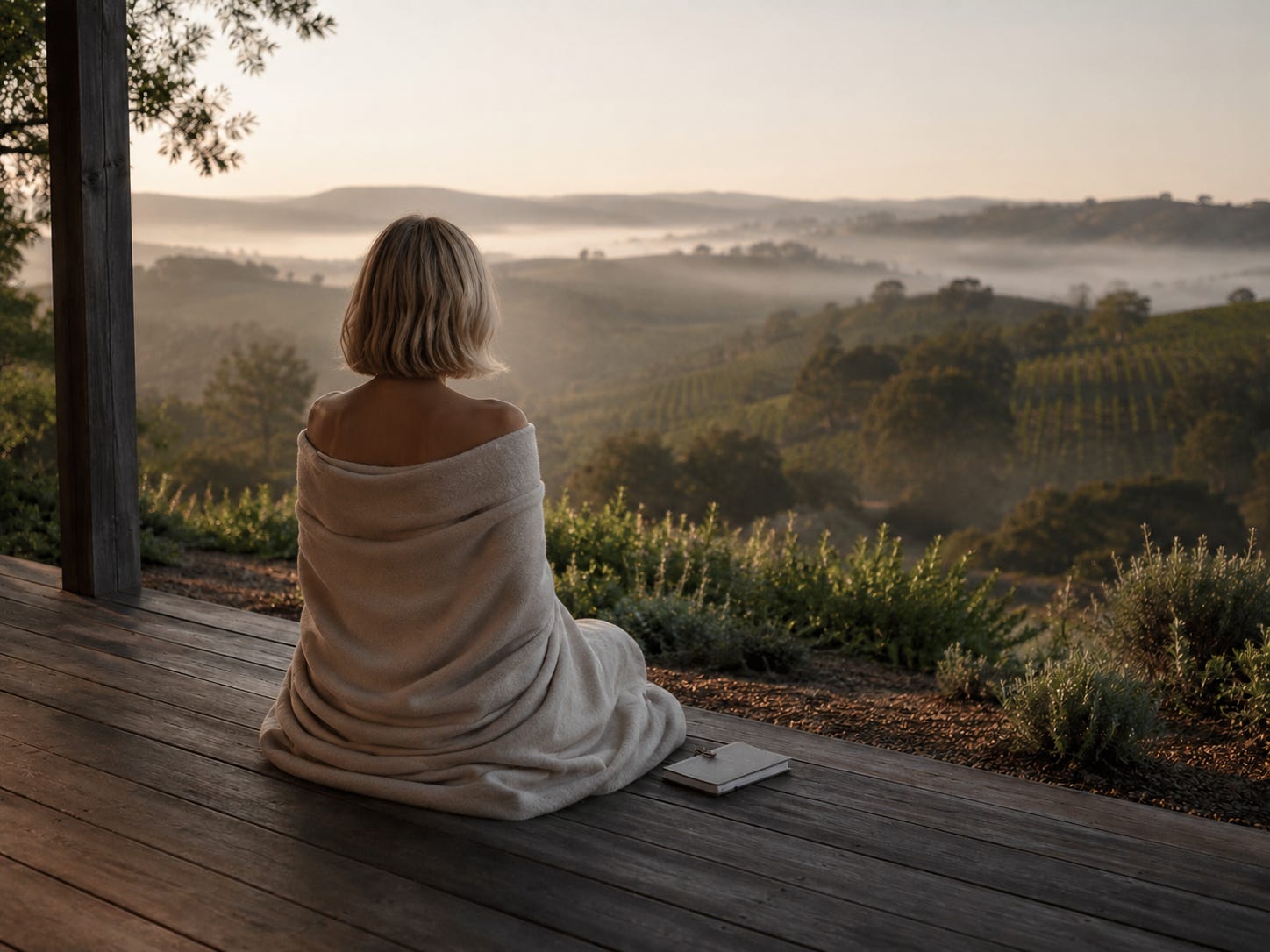
I am writing this wrapped in a towel the color of expensive organic oatmeal, still slightly breathless after the sunrise yoga class called Awakening the Inner Estuary. The title sounds to me less like yoga and more like a misplaced PDF for next year’s California tax proposal, but this morning we submitted to it anyway. We began on a deck damp with mist, wrapped in locally knitted goat-wool shawls we were encouraged to release with intention. Our guide, Solveig, whose clavicles have their own cult Instagram following, asked us to inhale abundance and exhale resistance.
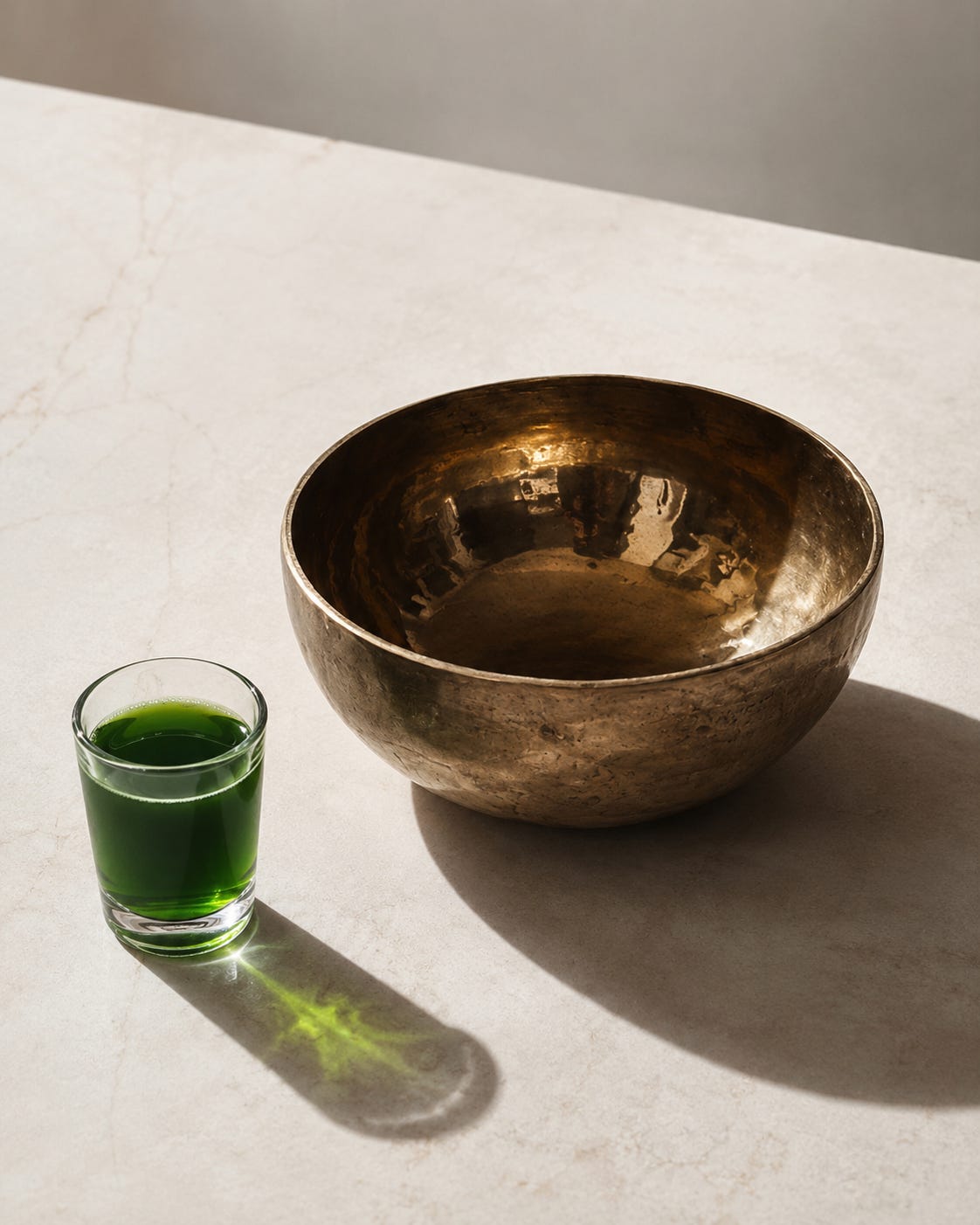
The resort itself, tucked into the gentle hills of Sonoma, is devoted to the recovery of sleep and relaxation, now apparently requiring professional supervision. It is a masterpiece of discreetly engineered tranquility. Every surface is pale wood, stone, linen, or occupied by a ceramic vessel suggesting that someone here ferments their own investment advice. There are bowls of green figs, small glasses of chlorophyll water everywhere, and hallways perfumed with hinoki, rosemary and the faint scent of AI wealth. Somewhere nearby water is always trickling. I have begun to suspect it has its own pink-noise channel on YouTube, to which I may already be subscribed.
This afternoon, after lectures on circadian reset and meal timing, we were led to the indoor pool for the floating sound bath, where relaxation was impeccably choreographed. We reclined on black floating pods, wrapped in silky beige shawls and wearing sleep masks, a small fleet of fragile parcels awaiting emotional delivery.
A chiseled man in linen trousers stood at the edge of the pool, drawing low metallic notes from Moroccan brass bowls. Solveig’s voice arrived softly, instructing us to progressively relax the muscles, the space behind the eyes, and finally the mind itself. The gentleman floating next to me began to snore, not very gently, but with the expertise of a man whose nervous system had accepted the treatment plan. I, meanwhile, slipped into that pleasant borderland between sleep and supervision, where dignity becomes someone else’s department. Just as the bowls thinned into silence, a long-forgotten memory bubbled up in my brain.
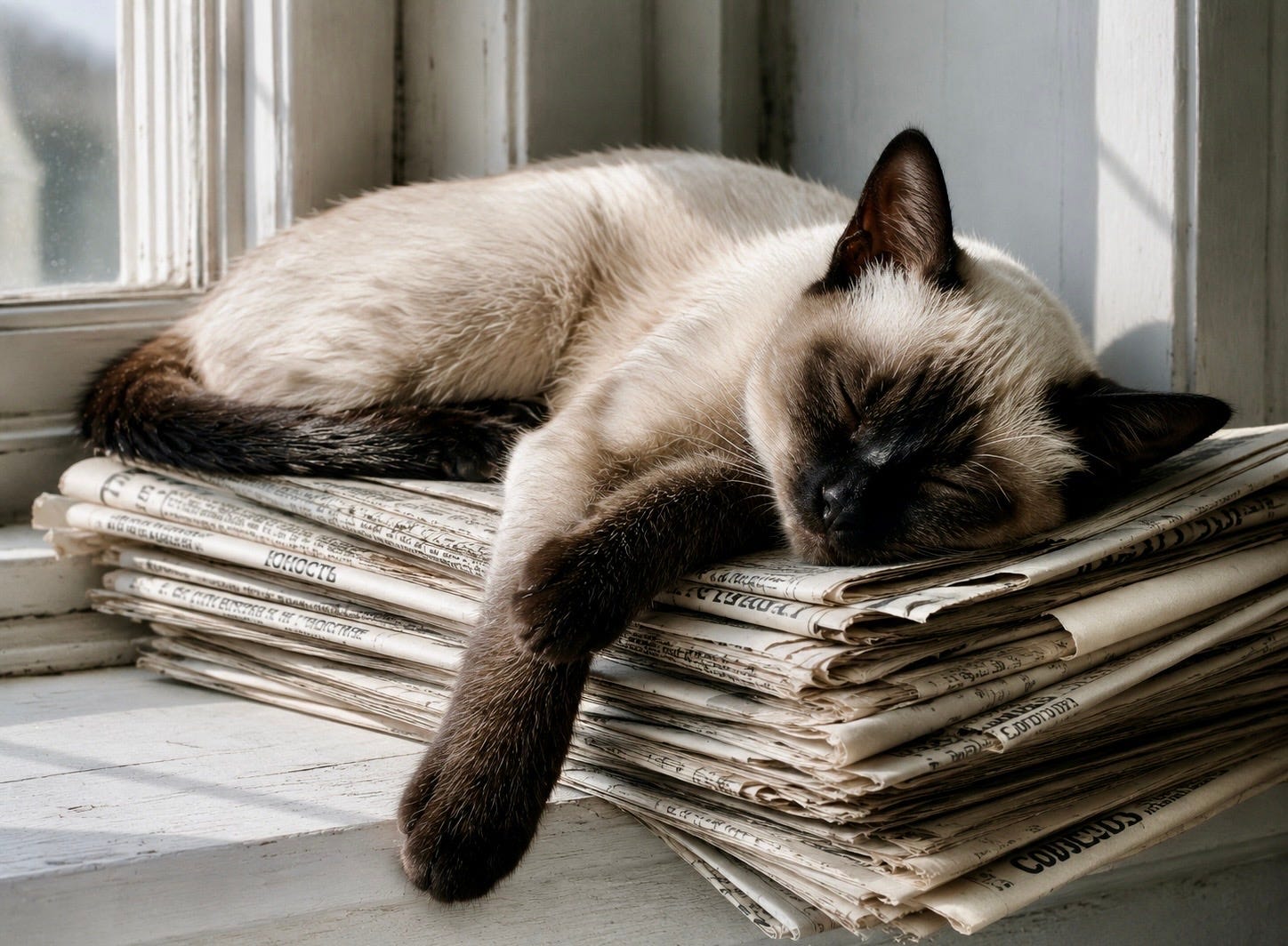
In the memory, I am sitting with my grandmother in our small kitchen after lunch, drinking Ceylon tea. Our Siamese cat is conducting his usual inspection of possible afternoon nap properties. He jumps onto the windowsill, considers a crooked pile of old newspapers, purrs for a few obligatory seconds, then lowers himself onto it with faith in gravity and humanity. Within moments, his body enters that peculiar liquid state available only to cats, poured over the papers as if his bones had been a temporary inconvenience.
“Look,” my grandmother says, amused and entirely serious. “This is a lesson in sleep and relaxation. Relax your mind and relax your muscles.”
This last phrase shudders me awake. I am not sure whether Solveig or my grandmother said it.
And there it was, the humbling realization, delivered with impeccable timing and a hefty receipt. Somewhere between the corporate career, family life, school forms, and the conviction that the inbox would explode if left unattended for an hour, I had lost the ability to nap in the afternoon. My grandmother did not visit a sleep retreat, but she had the sequence right: lower the body, soften the face, stop giving the mind new assignments. She would have hated the word glymphatic, but she understood the principle perfectly.
So the indictment, if there is one, belongs to our own twisted logic. Advice given in a kitchen with the cat as a prop sounds dated and sentimental. The same advice delivered beside a heated pool by a woman with cult clavicles sounds clinically actionable. Free rest is laziness; expensive rest is discipline. A nap from a grandmother is indulgence. A nap from Sonoma is nervous-system architecture. As I leave the retreat, I smile (while graciously accepting the parting tisane). We made rest expensive enough to respect
.
I like the analogy of the cat and grandma stating watch how the cat can relax. Perhaps we should all take a timeout during the day to relax and let go of all electronic devices. I am sure our bodies and mind would appreciate it.
Such a fascinating article :) it reframes napping not as a sign of laziness, but as a tool that can be deliberately designed to support cognition, mood, and performance. I appreciated your emphasis on timing and intention rather than simply encouraging people to sleep more. One aspect that particularly resonated with me as a physician-scientist is the recognition that not all naps are created equal. The physiological effects of a brief 10–20 minute nap differ substantially from those of longer naps that enter deeper sleep stages. Short naps can improve alertness and learning while minimizing sleep inertia, whereas longer naps may provide benefits related to memory consolidation and emotional processing but can also leave some individuals feeling groggy. Understanding sleep architecture allows us to use naps more intelligently rather than treating them as a one-size-fits-all intervention. For our longevity-focused patients and readers, I would love to add that the ability to nap effectively reflects a broader principle in physiology: performance and recovery are inseparable. The brain is not designed for continuous output without periods of restoration. Whether through nighttime sleep, short naps, or moments of quiet wakefulness, recovery is an active biological process involving synaptic homeostasis, metabolic clearance, and memory consolidation. In that sense, rest is not the opposite of productivity, but it is one of its prerequisites (!). What I find especially interesting is that cultures throughout history have intuitively incorporated midday rest into daily life, long before neuroscience began explaining its mechanisms. As modern schedules increasingly prioritize constant availability, we may have lost some appreciation for the value of strategic pauses. A well-timed nap, much like exercise or nutrition, can be viewed as another tool for enhancing resilience rather than an indulgence. Thank you for sharing such an insightful piece!